Introduction
There’s something genuinely satisfying about fresh citrus juice that processed, bottled versions never quite capture. The brightness of a freshly squeezed orange, the sharp tartness of a just-pressed lemon, the aromatic intensity of lime juice extracted seconds before it goes into a drink — these are qualities that begin diminishing the moment juice is separated from the fruit and exposed to air, light, and time. Bottled juices, even premium ones labeled “not from concentrate,” are a different product from what comes out of a freshly cut citrus fruit pressed over a juicer.
The tools used to extract that juice matter more than the minimal attention most people give them. The average household citrus juicer — a small plastic reamer on a catch basin — extracts juice adequately from soft fruit but struggles with larger, firmer citrus, requires significant hand strength for consistent pressing, and produces results that vary considerably with effort and technique. The result is juice that’s often incompletely extracted, leaving a meaningful portion of the fruit’s yield in the pressed half.
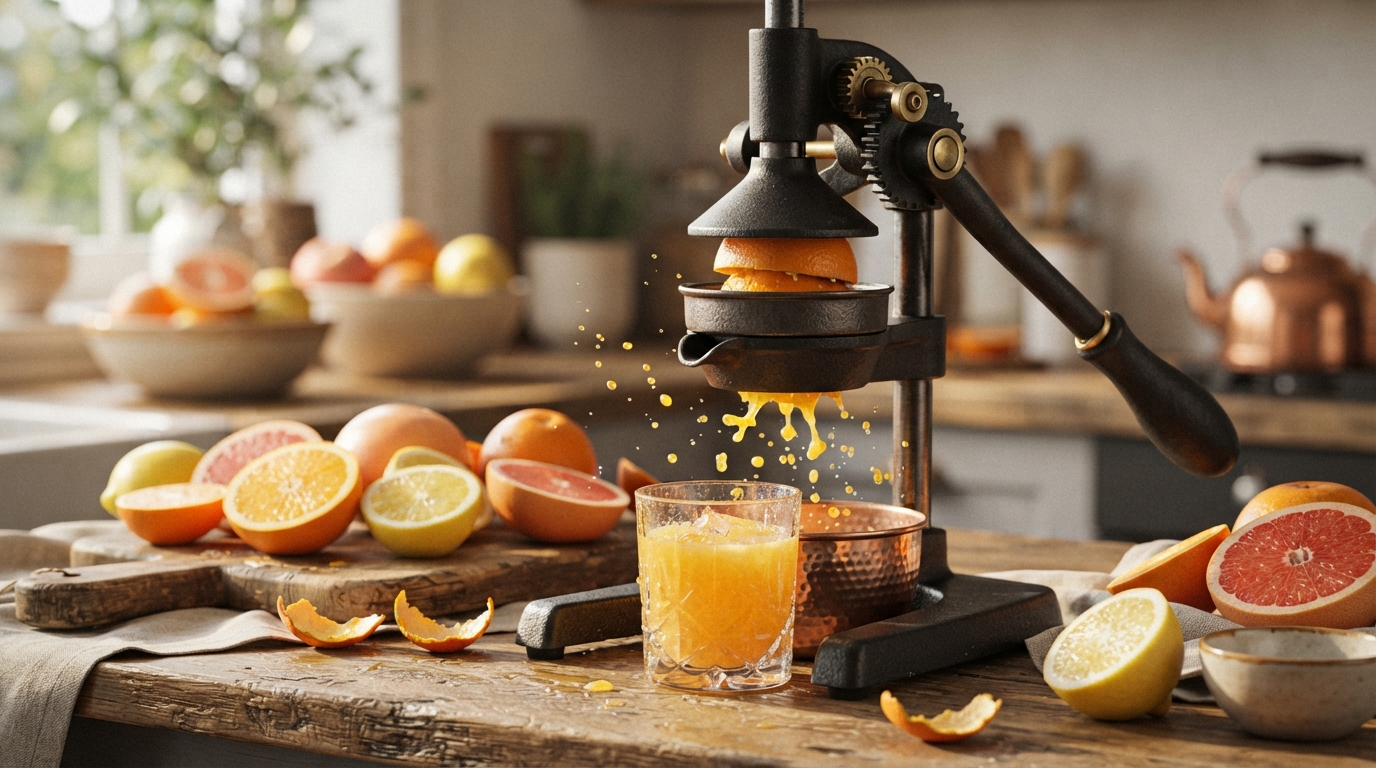
The Zulay Kitchen Cast Iron Juicer takes a fundamentally different approach to citrus pressing — not a reamer that requires twisting fruit against a fixed cone, but a lever-operated press that uses mechanical advantage to extract juice through direct compression. Cast iron construction, a lever arm that multiplies hand force into significant pressing pressure, and detachable strainers that allow the extraction and cleaning process to be separated from each other. This article examines what that approach actually delivers in practice, who it serves best, and what’s genuinely worth knowing before adding this juicer to a kitchen or bar setup.
What Is the Zulay Kitchen Cast Iron Juicer?
The Zulay Kitchen Cast Iron Juicer is a manual lever-press citrus juicer constructed from cast iron with a lever mechanism that generates pressing force through mechanical advantage rather than direct hand strength. Rather than rotating fruit against a reamer — the dominant design in household citrus juicers — this juicer compresses a halved citrus fruit between a bowl-shaped pressing cone and a strainer basket, extracting juice through direct pressure.
The cast iron construction gives the juicer substantial weight — it stays in place on a counter without sliding during pressing, unlike lighter plastic or aluminum models. Detachable strainers allow different mesh sizes to be used for different pulp preferences, and the strainer removes separately for cleaning rather than requiring the entire unit to be submerged or awkwardly maneuvered under running water.
The lever-press design is the same fundamental approach used by commercial bar juicers — the kind found in juice bars, restaurant bars, and cocktail-focused establishments where volume and consistency of extraction matter. The Zulay version brings that mechanism to a household scale at a price point that makes it accessible for home kitchens and home bars.
Key Features of the Zulay Kitchen Cast Iron Juicer
Cast Iron Construction
Cast iron is a material choice that carries significant practical implications for a countertop juicer that sees regular use.
The weight — substantial for a juicer of this size — is the most immediately apparent characteristic. A heavy base stays where it’s placed during pressing rather than requiring one hand to stabilize the unit while the other operates the lever. The pressing force generated by the lever mechanism is absorbed by the juicer’s own mass rather than requiring counter friction or hand stabilization. For a device used repetitively — pressing multiple oranges for a morning juice batch, working through a pile of lemons for a cocktail party — the stability of a weighted base that doesn’t move is a more significant practical advantage than it sounds.
Cast iron’s durability profile suits an appliance designed for heavy, repetitive use. The material doesn’t flex under pressing pressure, doesn’t develop stress cracks from repeated mechanical loading, and doesn’t degrade with moisture contact the way some metals do with consistent use around juice and water. Well-maintained cast iron develops a seasoned surface over time through use.
The cast iron construction also means this juicer has a different relationship with longevity than plastic or aluminum alternatives. Where plastic eventually fatigues and aluminum develops surface corrosion with inconsistent care, cast iron with basic maintenance — keeping it dry, applying occasional food-safe oil to prevent rust — lasts essentially indefinitely. This is a piece of equipment that, properly maintained, outlasts the kitchen it’s used in.
Lever Mechanism and Mechanical Advantage
The lever arm is the functional heart of the juicer and the element that most fundamentally differentiates it from handheld reamers and small electric juicers.
The mechanical principle is straightforward: the lever arm’s length multiplies the force applied at the handle into significantly greater pressing force at the juicing cone. A moderate downward pull on the lever handle generates several times that force at the point of contact with the fruit. This multiplication effect means juice extraction requires less hand and arm effort from the user while producing more complete extraction from the fruit — a combination that’s better for both the user and the yield.
For people who juice regularly and have experienced hand fatigue from repeated reamer-style pressing, the lever mechanism’s reduced effort requirement is a meaningful quality-of-life improvement. For people with reduced hand strength — whether from age, arthritis, or other factors — the lever mechanism may be the difference between citrus juicing being practically accessible or genuinely difficult.
The extraction completeness also improves compared to reamer pressing. Direct compression through a lever-operated cone extracts juice from the fruit’s cells more thoroughly than rotational friction against a fixed reamer. Less juice remains in the pressed fruit half, which is relevant both for yield per fruit and for the economics of juicing over time.
Detachable Strainers
The strainer system is one of the more practically useful design decisions in the Zulay juicer, and it operates on two levels.
First, the strainers catch seeds and larger pulp pieces during pressing, preventing them from passing through to the collected juice. This is standard functionality for any juicer. The advantage of a detachable rather than integrated strainer is that it can be quickly swapped for a different mesh size to adjust pulp quantity in the finished juice — finer mesh for cleaner juice, coarser mesh for more pulp content. Different citrus fruits also produce different amounts of pulp, and the ability to select an appropriate strainer for the fruit being pressed gives some control over the final product.
Second, the detachable design makes cleaning significantly more straightforward than juicers with integrated fixed strainers. Citrus juice residue, pulp, and seeds that accumulate in a strainer during pressing clean far more easily when the strainer can be removed and rinsed directly under running water, inspected, and cleaned thoroughly with a brush if needed. Fixed strainers on attached juicers require cleaning around mechanical obstacles and often leave residue in hard-to-reach areas.
For a juicer used daily, the ease of complete cleaning after each use directly affects both hygiene and the flavor of subsequent juicing sessions — residue from previous pressings can affect the taste of fresh juice if the equipment isn’t cleaned thoroughly.
Design for Volume and Repetitive Use
The juicer’s design — stable base, lever mechanism, removable strainer, collection basin of adequate capacity — reflects an orientation toward volume pressing rather than the occasional single-fruit squeeze.
Pressing a single lemon for a recipe is achievable with the smallest handheld citrus press. Where the Zulay cast iron juicer demonstrates its design rationale is in scenarios involving multiple fruits pressed in sequence: twelve oranges for a morning juice batch, twenty lemons for cocktail party lemonade, thirty limes for a large margarita batch. The stability that prevents counter sliding, the lever that reduces hand fatigue through repetitive pressing, the collection basin that holds meaningful volume before requiring emptying, and the removable strainer that enables quick cleaning between fruit types — all of these design elements serve volume use better than they serve the occasional single-fruit squeeze.
How the Zulay Cast Iron Juicer Can Be Used
Fresh Orange Juice for Daily or Weekly Batches
The most fundamental application is the one most households have for a citrus press — fresh orange juice in quantities appropriate to the household’s consumption. Pressing oranges through the lever mechanism produces more complete extraction per fruit than a reamer, which means slightly more juice per orange and slightly better economics on a per-glass basis over time.
For households that want to establish a habit of fresh-squeezed orange juice — something genuinely different in flavor and nutrition from bottled versions — the Zulay juicer’s ease of operation and stable pressing action makes the daily pressing routine less demanding than alternative methods.
Cocktail Bar and Home Bartending
This is where the juicer’s design most clearly finds its natural audience. Serious home bartenders who make cocktails from fresh citrus — as opposed to bottled lemon or lime juice — need to press meaningful quantities of citrus efficiently before service. Making a batch of margaritas for a group, a shaker full of whiskey sours, or multiple rounds of gimlets all require freshly pressed lime or lemon juice in quantities that become tedious with a handheld press and genuinely fatiguing with a small household reamer.
The lever mechanism makes pressing a dozen limes practical rather than exhausting. The stability of the cast iron base keeps the juicer in place while the lever is operated with one hand. The removable strainer allows quick cleanup between pressing different citrus types — lemons before the gin sours, limes for the margaritas — without fully cleaning the unit between each switch.
For bartenders — professional or enthusiastic home practitioners — the equipment investment in a proper press directly affects both the quality of finished cocktails (fresh juice is categorically better than bottled in cocktail applications) and the practical efficiency of preparation.
Lemonade and Fresh Citrus Drinks
Large-batch fresh lemonade — the kind made for a summer gathering, a children’s party, or a weekend pitcher — requires pressing a significant number of lemons. Pressing ten to fifteen lemons by hand with a small reamer is genuinely fatiguing. With the Zulay lever press, the same quantity is manageable without the accumulated hand strain that makes large-batch manual pressing unpleasant with other juicer types.
The detachable strainer makes the process cleaner — seeds and pulp are caught in the strainer rather than requiring straining after the fact, which simplifies the production process for large lemonade batches.
Juicing for Health and Nutritional Purposes
Households oriented around fresh juice as a health and nutrition practice often juice daily, and daily use is where the Zulay juicer’s durability advantage over plastic alternatives becomes most relevant. A cast iron juicer pressed daily over years maintains its function without the surface degradation, plastic fatigue, or mechanism loosening that accumulates in lighter-duty alternatives under comparable use frequency.
Fresh citrus juice consumed as part of a health-oriented routine — lemon water in the morning, fresh orange juice as a vitamin C source, lime juice in smoothies — benefits from equipment that makes the daily preparation routine efficient rather than laborious. The lever mechanism’s ease of operation reduces the activation energy of the daily habit to a lower threshold.
Extracting Juice for Cooking and Marinades
Many cooking applications call for fresh citrus juice — marinades, salad dressings, sauces, braises, desserts. Using the Zulay juicer for cooking applications produces more juice per fruit and cleaner extraction than squeezing by hand or pressing a cut fruit with a fork, which is particularly relevant in cooking contexts where a recipe calls for a specific volume of citrus juice and maximizing yield per fruit reduces how many fruits need to be used.
Who the Zulay Cast Iron Juicer May Be Suitable For
Serious Home Bartenders
The overlap between cocktail enthusiasts and this juicer’s design is substantial. Fresh citrus juice is one of the most impactful quality differences between home cocktails and bar-quality drinks, and having equipment that makes pressing fresh juice efficient before service changes whether fresh juice is actually used consistently or whether convenience-driven shortcuts (bottled juice, stored juice) become the norm. For the home bartender committed to fresh citrus in their drinks, the cast iron press is the natural tool.
Daily Fresh Juice Households
Households where fresh-squeezed citrus juice appears on the breakfast table regularly enough to justify dedicated equipment benefit from the lever mechanism’s ease and the cast iron’s durability. The combination of reduced effort per pressing and equipment that lasts through years of daily use represents a better long-term choice than lighter-duty alternatives for households with genuine daily juice habits.
Health-Conscious Daily Juicers
For individuals whose health routines involve fresh citrus daily — morning lemon water, fresh orange juice, lime in morning smoothies — the cumulative ease advantage of a lever press over months and years of daily use is meaningful. The daily habit is easier to maintain when the equipment makes it effortless rather than mildly effortful.
People with Hand Strength Limitations
Arthritis, joint issues, reduced grip strength, and other factors that make sustained gripping and twisting difficult are directly relevant to juicer selection. The lever mechanism’s force multiplication reduces the hand strength required for effective juice extraction, making fresh citrus juicing practically accessible for people who find reamer-style pressing genuinely difficult or painful.
Culinary Enthusiasts and Food-Focused Households
Households where cooking is a genuine interest and fresh ingredients are a consistent priority tend to be the households where a cast iron juicer earns its counter space through regular use. If fresh citrus appears in cooking several times per week — in salad dressings, sauces, marinades, desserts, and drinks — having equipment designed for efficient, complete extraction serves those habits better than a minimal basic juicer.
Gift Buyers for Kitchen Enthusiasts
The Zulay cast iron juicer is the kind of kitchen tool that photographs well, has obvious functional purpose, and feels like an upgrade rather than a basic household supply. For someone buying a gift for a person who takes their kitchen equipment seriously — a home bartender, a cooking enthusiast, a health-focused juicer — this juicer communicates thoughtfulness about the recipient’s specific interests.
Important Things to Consider
Cast Iron Requires Basic Maintenance
Cast iron is not a maintenance-free material, and understanding its requirements before purchasing prevents frustration and equipment damage.
Cast iron rusts when moisture is left in contact with the metal surface for extended periods without protection. After each use, the juicer should be rinsed, dried thoroughly — immediately and completely, not left to air dry — and stored dry. Periodic application of a thin layer of food-safe oil (food-grade mineral oil, coconut oil, or similar) to the cast iron surfaces prevents rust and maintains the metal’s condition.
This maintenance routine is brief and, once habitual, barely noticeable. But it’s genuinely non-optional for cast iron — the rusting that develops from consistent moisture exposure on unmaintained cast iron can affect both appearance and food safety. For households accustomed to putting kitchen tools in the dishwasher or leaving them to air dry without concern, the cast iron juicer requires a different maintenance mindset.
Size and Counter Weight
The cast iron juicer is heavier than plastic or aluminum alternatives of comparable size. This weight is an operational advantage — the stability it provides during pressing. But it’s also a practical consideration for storage and movement. Lifting and moving the juicer repeatedly between counter, cabinet, and use position is a different physical proposition than handling a lightweight plastic juicer.
For households where the juicer will live permanently on the counter, this consideration is minimal. For those who store equipment between uses and retrieve it when needed, the weight is worth factoring into storage placement decisions.
Not Designed for Non-Citrus Juicing
The lever-press design is optimized for citrus fruits — the half-fruit-in-press geometry is specific to cutting a citrus fruit in half and pressing each half. Pomegranates, grapes, apples, ginger, and other non-citrus juicing applications don’t fit this format. Households wanting a multi-purpose juicer that handles vegetables and non-citrus fruits need either a dedicated centrifugal or masticating juicer for those applications or a different appliance category entirely. The Zulay juicer is specifically and excellently a citrus press — not a general-purpose juicer.
Yield Expectations Are Fruit-Dependent
The juicer’s lever mechanism extracts juice more completely than hand pressing or small reamers, but juice yield is ultimately determined by the fruit — its variety, ripeness, temperature, and size. Room-temperature citrus yields more juice than refrigerator-cold fruit. Ripe, heavy fruit yields more than underripe or dry fruit. Pressing technique — placing the cut fruit face-down over the press cone, applying steady lever pressure rather than sudden force — also affects yield. Understanding that equipment quality affects extraction efficiency but doesn’t override the fruit’s inherent juice content sets realistic expectations.
How Manual Cast Iron Pressing Compares to Other Citrus Juicing Methods
Against Handheld Citrus Reamers
The basic citrus reamer — a cone-shaped tool on a handle, held by hand and rotated against a cut fruit half — is the simplest and lowest-cost citrus juicing method. It requires no counter space beyond the moment of use, costs almost nothing, and handles occasional single-fruit juicing adequately. Its limitations become apparent with volume: hand strength and wrist motion fatigue quickly over multiple fruits, extraction is incomplete compared to press-based methods, and seed and pulp management requires additional straining steps.
The Zulay cast iron juicer trades the reamer’s minimal cost and zero counter space for significantly better ergonomics over volume pressing, more complete extraction, and integrated seed/pulp management through the strainer. For households pressing more than two or three citrus fruits at a time with any regularity, the practical advantages of the lever press over the handheld reamer are immediate and consistent.
Against Small Plastic Lever Presses
Small plastic or aluminum lever citrus presses — the handheld squeezer design where a hinged lever squeezes a halved fruit against a perforated cup — are widely available at low price points and work well for their intended use. They’re appropriate for small quantities and occasional use, portable for travel or outdoor use, and require minimal storage space.
Their limitations emerge with volume and frequency. Plastic fatigue over repeated use, aluminum corrosion from citrus acid contact, and the smaller pressing surface and limited force generation compared to a cast iron lever press all affect performance over time with regular high-volume use. The Zulay cast iron juicer is built for the volume and frequency that these smaller alternatives handle with diminishing quality.
Against Countertop Electric Juicers
Electric citrus juicers — ranging from small household models with rotating reamers to more powerful centrifugal machines — handle volume with less physical effort than any manual method. They’re appropriate for very high volume requirements and for households where the ease of electric operation outweighs other considerations.
The trade-offs of electric juicers versus the Zulay manual press include noise (electric motors produce significant sound, relevant in early morning juicing situations), complexity (electric mechanisms have more components that can fail), and the specific quality dimension that some citrus enthusiasts note: the manual pressing method is gentler on citrus oils and aromatics than high-speed electric rotation, producing juice with somewhat more aromatic character than electric extraction.
For volumes where manual pressing is practical — household quantities up to several pounds of fruit per session — the Zulay cast iron juicer produces results with less noise, simpler maintenance, and arguably better aromatic quality than electric alternatives, at the cost of more physical involvement.
Against Integrated Citrus Press Attachments for Stand Mixers
KitchenAid and similar stand mixer brands offer citrus press attachments that use the mixer’s motor for powered pressing. These are effective and convenient for households that already own a compatible stand mixer, but they require setup and teardown of the attachment, cleaning multiple components, and the physical bulk of a stand mixer for what is fundamentally a simple task.
The Zulay juicer’s simpler setup — place on counter, cut fruit, press, pour — and focused single-purpose design makes it more practical for daily or frequent citrus pressing than the multiple steps involved in attaching, using, and cleaning a stand mixer citrus attachment.
Frequently Asked Questions
What size citrus fruits fit in the Zulay cast iron juicer?
The juicer accommodates standard citrus varieties including limes, lemons, small oranges, and Meyer lemons comfortably. Larger navel oranges and grapefruits may require checking fit against the pressing cup dimensions. The juicer is designed for standard household citrus sizes rather than the largest commercial citrus varieties.
Does the cast iron affect the taste of the juice?
Properly maintained cast iron with a seasoned surface does not impart flavor to citrus juice. Raw, unseasoned cast iron can affect taste and is not food-safe for acidic applications. The Zulay juicer should be used with its surface in appropriate condition — clean, dry, and oiled — rather than with a neglected or rusting surface.
How do I prevent the juicer from rusting?
Rinse after each use, dry immediately and thoroughly with a clean cloth — don’t leave it to air dry. Apply a thin layer of food-safe oil to the cast iron surfaces periodically, particularly if the juicer is stored rather than used daily. Store in a dry location rather than near a sink or in a humid environment. These steps, consistently applied, keep cast iron in excellent condition indefinitely.
How much juice does one orange typically yield with this juicer?
Juice yield varies with orange size, variety, and ripeness. A medium navel orange at room temperature typically yields 2 to 3 ounces of juice. Valencia oranges, which have higher juice content by design, yield somewhat more. Refrigerator-cold oranges yield less than room-temperature fruit — allowing citrus to come to room temperature before pressing improves yield noticeably.
Can I use the juicer for pomegranates or other fruits?
The lever-press design is specific to citrus halves. Pomegranates, grapes, and other non-citrus fruits don’t fit the half-fruit-on-press geometry. For non-citrus juicing applications, a different juicer type is more appropriate.
How does the strainer removal work and how often should it be cleaned?
The strainer detaches from the collection basin for cleaning. After each pressing session, the strainer should be removed, rinsed under running water to clear seeds and pulp, and cleaned with a soft brush if needed to clear mesh openings. Citrus pulp dries quickly and becomes harder to remove if the strainer isn’t cleaned promptly after use. The detachable design makes immediate cleaning quick enough that leaving it for later is rarely justified.
Is the juicer appropriate for someone with arthritis or limited hand strength?
The lever mechanism reduces the grip and twisting strength required compared to reamer-style juicers, making pressing more accessible for people with hand strength limitations. The handle can be operated with a downward pushing motion rather than gripping and squeezing, which is generally more comfortable for people with grip-related difficulties. Individuals with specific hand conditions should assess the lever operation design against their particular situation.
How stable is the juicer on the counter during pressing?
The cast iron weight provides significant stability during pressing. The juicer stays in place on a counter without sliding during normal lever operation. A non-slip mat beneath the base provides additional stability on very smooth counter surfaces if needed.
Conclusion
The Zulay Kitchen Cast Iron Juicer earns its counter space through a design that takes manual citrus pressing seriously — not as a minimal household task accomplished with the cheapest available tool, but as a regular activity that benefits from equipment built for the purpose. The cast iron construction’s stability and durability, the lever mechanism’s force multiplication and reduced fatigue, and the detachable strainer’s practical contribution to cleaning efficiency all reflect the orientation of an appliance designed for frequent, volume use rather than occasional light-duty pressing.
Its natural audience is specific and clear: home bartenders who make cocktails from fresh citrus, households with genuine daily fresh juice habits, health-focused individuals pressing citrus regularly as part of their nutrition routine, and anyone who has experienced the fatigue and incomplete extraction of reamer-style pressing for quantities beyond a single fruit. For these users, the cast iron lever press isn’t a luxury kitchen item — it’s the right tool for how they actually cook and drink.
The cast iron maintenance requirement is real and non-optional, the design is specific to citrus and doesn’t extend to other juicing applications, and the weight and counter presence require planned accommodation. Within those honest parameters, this is a piece of equipment built to last and designed to make frequent citrus pressing genuinely pleasant rather than effortful.